
Workers Must Adapt to Changing Realities, Says Saeed Ghani As Sindh Moves Towards Universal Social Security

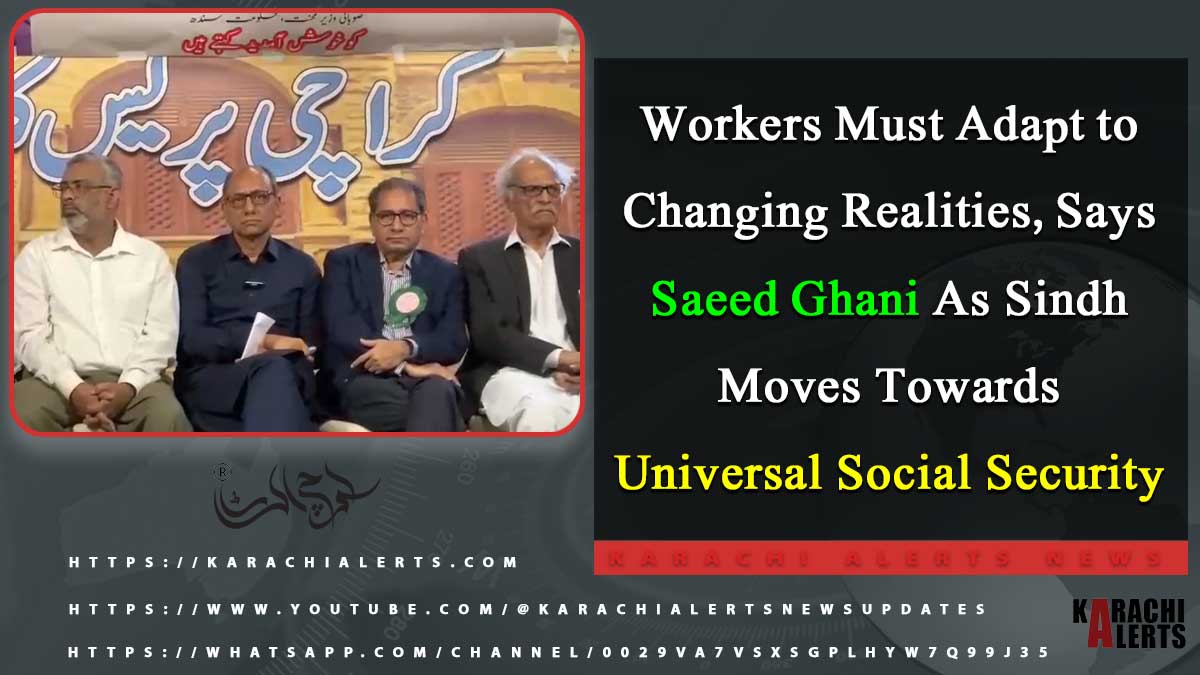
Workers Must Adapt to Changing Realities, Says Saeed Ghani As Sindh Moves Towards Universal Social Security
Karachi : Sindh Minister for Labour, Human Resources, and Social Protection, Saeed Ghani, has warned that if trade unionists continue to follow outdated methods of labour politics, the labour movement will decline even further over the next decade.
He urged workers’ representatives to adapt to changing times and evolving circumstances to safeguard their future.
Speaking as the chief guest at the oath-taking ceremony of the newly elected office-bearers of the All Pakistan Newspapers Employees Confederation (APNEC) at the Karachi Press Club on Sunday, Ghani said that significant reform within trade unions was essential.
He added that the process of universalising social security had begun, with the launch of the Benazir Mazdoor Card being an important step in that direction.
Ghani said the government aimed to bring every category of worker — including journalists, private-sector employees, rickshaw and taxi drivers, private drivers, and street vendors — under the social security net.
He explained that the initiative would provide free, high-quality education for workers’ children and free medical facilities for their entire families, including their parents. Congratulating the newly elected APNEC chairman and office-bearers, Ghani recalled his own journey from trade union activism to provincial politics.
He said he had never been ashamed of being a trade union worker and had always regarded his political ascent as part of a collective struggle with his fellow workers. Ghani noted that he was serving as Labour Minister for the third time and that the Pakistan Peoples Party’s policy on workers’ welfare remained clear and consistent: “We are pro-labour and pro-worker, and our stance will remain inclined towards workers and their unions.”
He acknowledged that his pace of work in the current term was slower due to several ongoing reforms. Ghani highlighted that the existing laws of the Social Security and Workers Welfare Board applied only to industrial workers, whose contributions were paid by their employers. To expand coverage, he said the previous PPP government had initiated the concept of universal social security in 2008.
He explained that under the revised Social Security Act, self-employed and informal-sector workers could also be registered, though a complete mechanism was still being developed. The Benazir Mazdoor Card, he said, would eventually extend beyond the 600,000 registered industrial workers to millions of other labourers across Sindh. Ghani said one challenge still under discussion was the question of contributions from self-employed workers. While some leaders, including PPP Chairman Bilawal Bhutto-Zardari, had suggested waiving contributions and having the government cover the cost, Ghani said this was unsustainable. If the universalisation of social security brought the number of beneficiaries to 5–10 million, no government could bear the entire financial burden.
He argued that partial contributions were necessary to ensure workers’ ownership of the programme. For instance, he said that if informal-sector workers contributed even Rs2,000 a month, they would receive benefits of far greater value in return — including free schooling for multiple children and comprehensive medical care for their entire families.
Ghani criticised past schemes in which free rickshaws or plots were given to workers, only for many beneficiaries to sell them cheaply, leaving the projects ineffective. He said similar failures would occur if social security benefits were provided entirely free. The Labour Minister added that large-scale corruption in housing schemes under the Workers Welfare Board had led to billions being wasted on just 10,000 flats in 50 years.
Instead, he proposed giving each retiring employee a residential plot along with some financial support, allowing them to build and maintain their own homes. Ghani said Pakistan had witnessed decline across all sectors — politics, judiciary, media, and others — over the last 15 to 25 years. However, unlike employers who had adapted their methods and policies, trade unions had remained stuck in practices from 50 to 70 years ago. If this continued, he warned, they would fall even further behind.
He said unions were often perceived negatively in society, associated with laziness or disruption, while management received credit for institutional successes but blamed unions for failures. He argued that if management deserved credit for progress, it must also share responsibility for decline, as corrupt unions could only exist under corrupt management.
Ghani called on union leaders to reflect deeply on how to modernise their methods and correct internal flaws. He acknowledged resource limitations in enforcing labour laws such as the minimum wage but assured that wherever credible complaints were received, action had been taken, and would continue to be taken.
He urged workers to report violations directly so the Labour Department could intervene. He also clarified that the Rs40,000 minimum wage referred to unskilled workers, while skilled workers fell under different, higher wage categories. Ghani reaffirmed his commitment to supporting all trade unions in Sindh.
He also said he would consider the proposal for an implementation commission, adding that if legally feasible, Sindh — already ahead of the federal government in many such initiatives — would certainly establish one. He concluded by expressing hope that with the right direction and reforms, future generations of workers would enjoy a stronger, fairer labour system in Sindh.